KnotEnufKnitting
  • Home
  • Patterns
  • About
  • Contact
  • Blog
    • Blog

      Top 10 Knitting Patterns of 2025

      December 29, 2025

      Blog

      Mystery Knit Afghan 2026

      December 4, 2025

      Blog

      How to bind off the last stitch

      November 13, 2025

      Blog

      My Knitting Mishap

      September 23, 2025

      Blog

      Learn to knit the C4F/C4B cable stitch without a cable needle KAL

      April 9, 2025

  • Shops
  • Shop
Cable the C2RP without a cable needle
Cable the C2LP without a cable needle
Mystery Knit Cable Scarf 2026
Cable the C2B without a Cable needle
Cable the C2F without a Cable needle
Cables Made Simple – Potholder KAL
Top 10 Knitting Patterns of 2025
Mystery Knit Afghan 2026
Easy knit bind off with a Crochet hook
Double Chain Cast on – How to work...
Unlocking the Easiest Provisional Cast-On Ever
Learn to knit the C4F/C4B cable stitch without...
How to knit the 1/1/1 LC without a...
Top 10 Hat Knitting Patterns of 2024
Top 10 Knitting patterns of 2024
Mystery Knit Afghan 2025
Top 10 knitting patterns of 2023
Mystery Knit Afghan 2024
TOP 5 MOST LOVED KNITTING PATTERNS 2023
Double Chain Cast-On for Circular knitting – The...
How to Knit the Double Chain Cast on
How to Knit Neat Edges
Knit Like a Pro: Continental Style for Faster...
TOP 10 KNITTING PATTERNS OF 2022
Mindfulness Mystery Knit Afghan 2023
How to pick up stitches along a slipped...
Cable the C4LP without a cable needle
Cable the C4B without a cable needle
Cable the C4F without a cable needle
Knit By the Woodstove Hat knitting pattern
Tips to avoid crossing cables in the wrong...

KnotEnufKnitting

Modern, Seamless Knitting Patterns

  • Home
  • Patterns
  • About
  • Contact
  • Blog
    • Blog

      Top 10 Knitting Patterns of 2025

      December 29, 2025

      Blog

      Mystery Knit Afghan 2026

      December 4, 2025

      Blog

      How to bind off the last stitch

      November 13, 2025

      Blog

      My Knitting Mishap

      September 23, 2025

      Blog

      Learn to knit the C4F/C4B cable stitch without a cable needle KAL

      April 9, 2025

  • Shops
  • Shop
Tutorial

How to Calculate Gauge for a Knitting Pattern

written by KnotEnufKnitting January 27, 2023

Gauge is the stitch and row count in 1″ (2.5 cm) square bit of knit fabric.   Usually, gauge is measured in 4″ x 4″ (10 cm x 10 cm) to make it easier to calculate.   

How do you measure gauge?

Using the stitch pattern that the knitting pattern designer states, you will knit a swatch of the pattern. This will be a rectangle piece that you can use to measure the amount of stitches and rows you have per inch. After you have knit the swatch, you can count the stitches using a ruler. It is best to count the stitches over 4″ (10 cm). If you have too many stitches, you will need to try larger needles. If you have too few stitches, you will need to try smaller needles.

You also measure the amount of rows / 4″ (10 cm) in the same manner. After you have knit the swatch, you will count the number of rows / inch. If you have too few rows, you will need to use smaller needles. If you have too many rows, you will need to try larger needles.

Why do you want to measure gauge? 

Every designer designs their patterns with a specific gauge.  This accounts for the amount of stitches and number of rows required to knit the correct dimensions.  If you are off a little bit in the gauge, it can make the finished product too large or too small.  This can be a great disappointment when one takes so much time and effort to knit. 

For example, if you are knitting a sweater and the gauge is 18 stitches / 4″ and you have 20 stitches / 4″, your finished garment will be too small.  If the finished circumference is supposed to be 20″, your sweater will be 18″ around. In this case, having 20 stitches in 4″ instead of 18, makes your sweater 2″ too small.   It makes a difference.  In a sweater, if the row gauge is out, it will result in the yoke of your sweater being too short or too long.  Sometimes, you can adjust for this, but you have to know how.  

Does gauge always matter?

It depends on what you are knitting.  Hats, sweaters, socks, and pretty much any other item you wear, gauge is very important.  The designer uses the gauge to design each portion of the garment.  

Blankets can be more forgiving if you don’t mind having a smaller or larger blanket.  But, if you are not going to be happy with the result, it is always important to check the gauge first.  That way, you will always be happy with the item you have knit. 

Why is my gauge different from the designers? 

Everyone knits differently with different tension.  Some are tight knitters and some are loose knitters.  Often, the designer uses the average gauge to design for the specific yarn.  After you have knit for some time, you will realize where you fit against the average knitter.  You may have to choose a larger needle to get gauge if you are a tight knitter.  If you are a loose knitter, you will have to choose a smaller needle to get the right gauge.  How much larger or smaller varies with each person.  The more you practice your gauge, the more you will realize where you are on the knitting spectrum. 

What stitch pattern is chosen to calculate the gauge? 

This also depends on the individual pattern.  Sometimes, when there is a specific stitch pattern used throughout the pattern, the designer will use it for calculating the gauge.  Often, when I am designing a pattern with many different designs, I will use the basic gauge pattern of stockinette stitch.  This is usually a good indication for how a knitter knits.  If you get the right stockinette gauge, it transfers to the rest of the stitch patterns.  

Example:

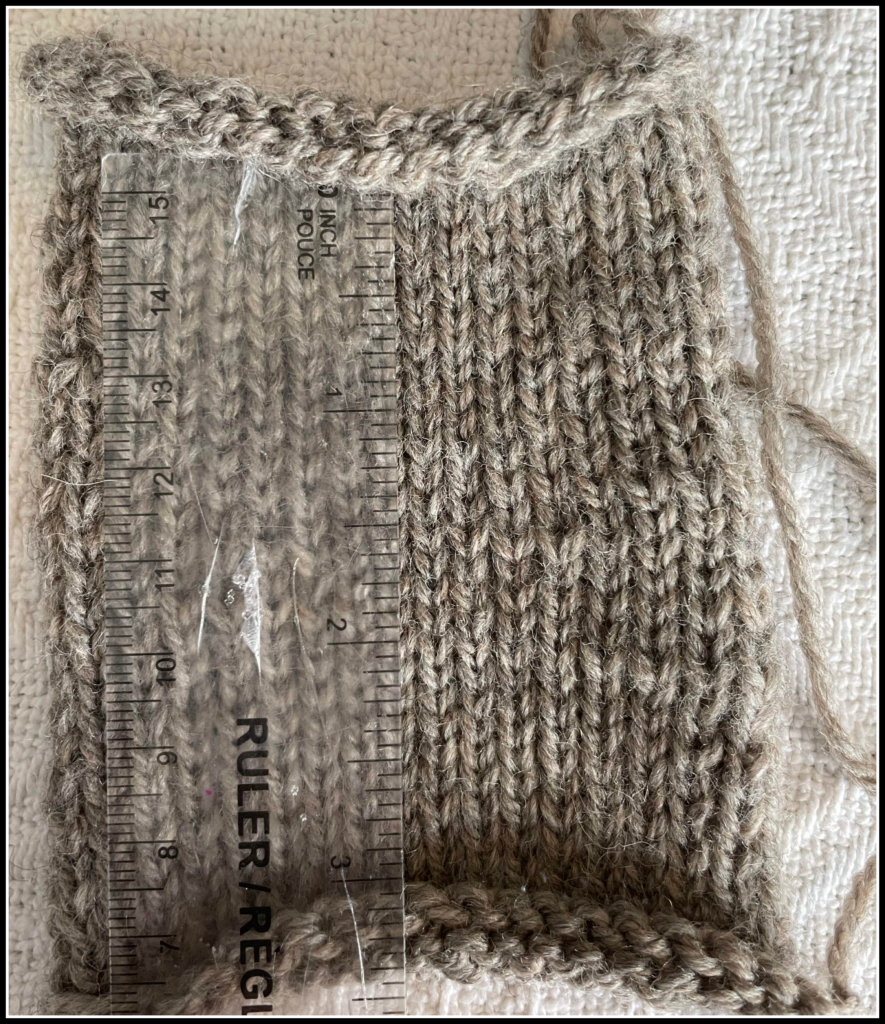
I have knit to different gauge swatches.  The pattern is 18 stitches / 26 rows = 4″ x 4″ (10 cm x 10 cm).  I used two different needles to get two totally different results.   You can see how this would make a huge difference on the pattern I would be knitting. 
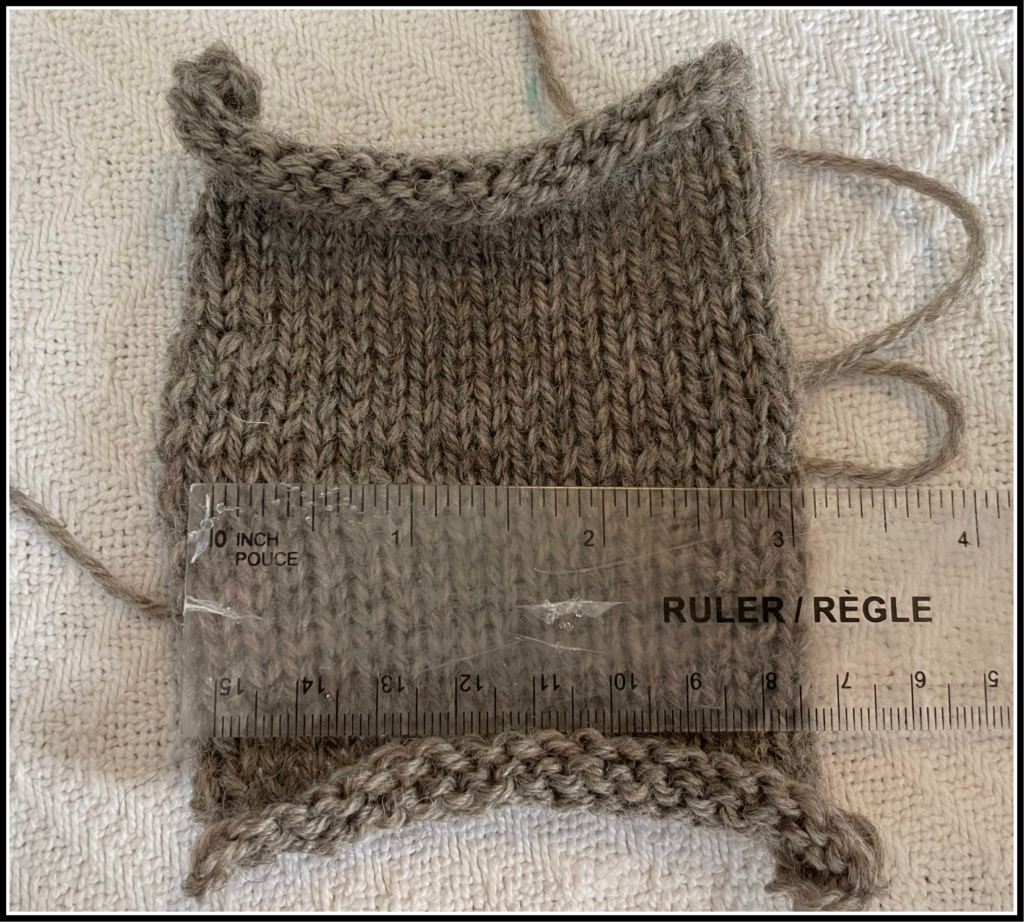
In the above pictures, I used US 4 (3.5 mm) needles. The gauge I got on this swatch was 17 stitches / 3″ (7.5 cm). That is an inch below the given gauge of 4″ (10 cm) per 18 stitches. My row gauge was 25 rows / 3″ (10 cm). Once again, it is almost 1″ below the required row gauge.
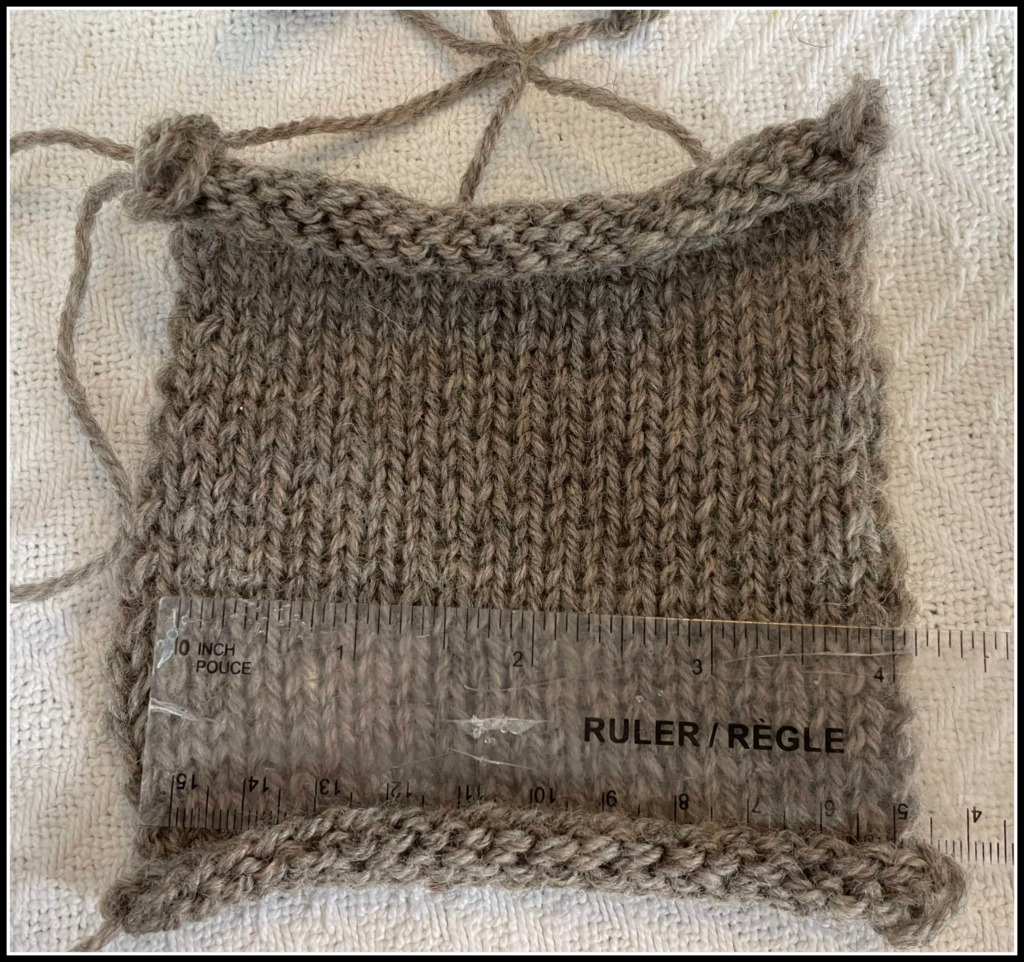
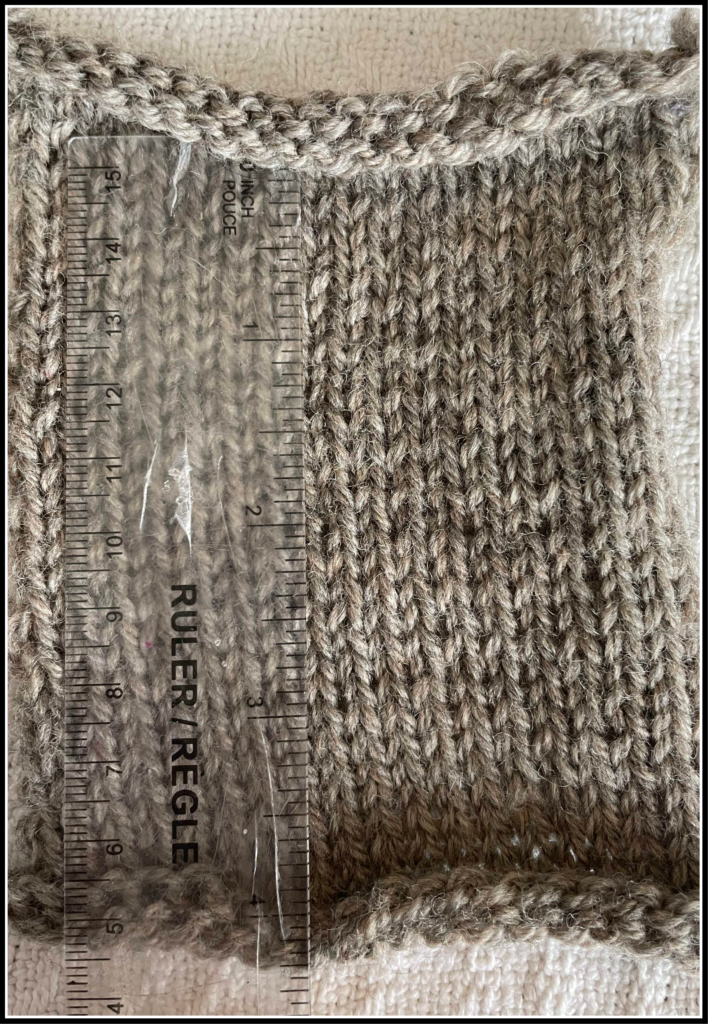
In these next pictures, I used US 8 (5 mm) needles. I got the correct gauge of 18 stitches / 26 = 4″ x 4″ (10 cm x 10 cm). These would be the needles I would use to knit this knitting project.
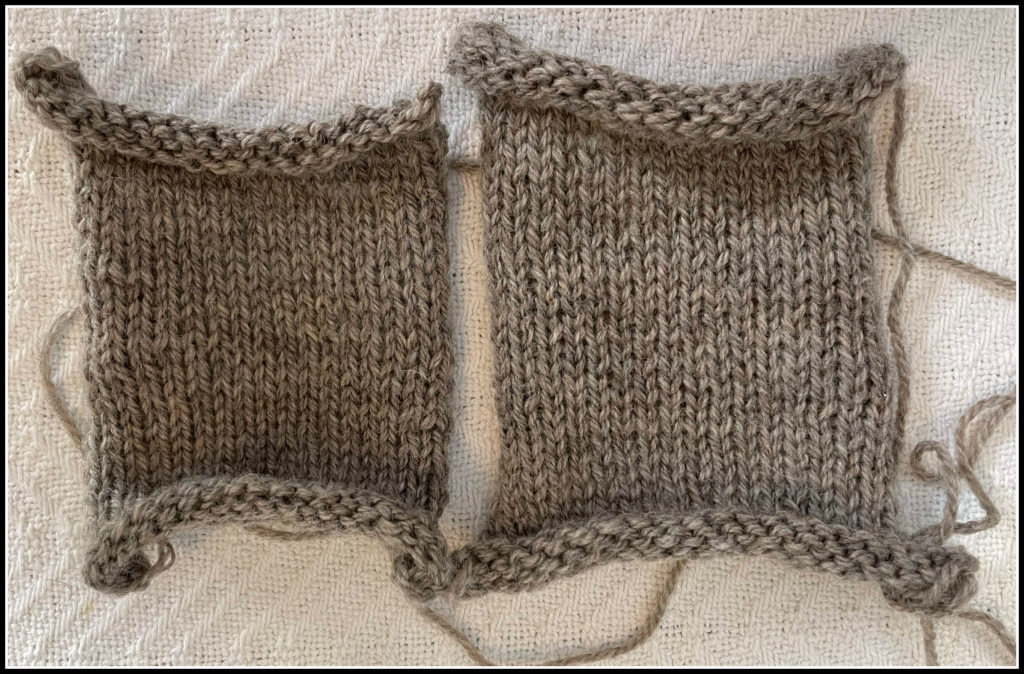
The above picture shows the two knitting swatches side by side. There is a huge difference in their size. If you knit two sweaters using those two different needle sizes, the end result would be two completely different size sweaters. Thus, Gauge is very important!

How to Calculate Gauge for a Knitting Pattern was last modified: January 27th, 2023 by KnotEnufKnitting
0 comment
0
Facebook Twitter Google + Pinterest
KnotEnufKnitting

previous post
TOP 10 KNITTING PATTERNS OF 2022
next post
Knit Like a Pro: Continental Style for Faster Knitting”

You may also like

How to join two sections of yarn while knitting

February 14, 2024

How to join yarn on the WS

January 25, 2024

Double Chain Cast on – How to work the first row

October 15, 2025

How to Wrap stitches while knitting

November 15, 2023

Simple Raglan Sweater Tutorial Step 4

May 26, 2023

HOW TO WORK THE CUSTOM STITCH ON THE MEMORY BLANKET

December 16, 2022

How to work the crown of a hat using 2 circular needles

October 11, 2023

Cable 4 Front (C4F) without a cable needle

February 15, 2024

Cable the C2F without a Cable needle

January 23, 2026

Knit the 1/1/1 LPC without a cable needle

January 8, 2026

KnotEnufKnitting

Welcome! At KnotEnufKnitting, we're all about seamless knitting patterns. Never sew together your knits again! Inspired by nature, Lara Simonson designs patterns that are one of a kind. Lara is committed to brining you easy to follow, engaging knitting patterns that the recipient is going to love. Have a look at our patterns here on the website, and don't forget to sign up for the newsletter to receive knitting tips, and be the first to hear about new patterns and deals!

Testimonials

"This is officially my favorite knitted project (and that’s over 10 years of knitting!)"(Joy Cardigan)

"This sweater pattern is easy, pretty, fun to knit, and looks so professional! Even picking up stitches which isn't too easy for me, she makes it easy to do! It's great, can't wait to finish it and begin the hat that goes with it. Lara is patient and answered all my questions and dealt with my frustrations!" (Little Elsa's Sweater)

Lara – Knit Designer

Lara – Knit Designer

I love knitting and creating! I've been knitting for 12 years. I enjoyed designing my own knitting, and started KnotEnufKnitting in 2013. I hope you enjoy my patterns! Happy Knitting :)

Recent Posts

  • Cable the C4LP without a cable needle
  • Cable the C4B without a cable needle
  • Cable the C4F without a cable needle
  • Cable the C2RP without a cable needle
  • Cable the C2LP without a cable needle

Recent Comments

  • KnotEnufKnitting on Patterns
  • Wendy o sullivan on Patterns
  • Joanne Ellis on Top 10 Knitting Patterns of 2018
  • Jane Neill on Patterns
  • KnotEnufKnitting on Mystery Knit Shawl Knitalong

Archives

  • April 2026
  • March 2026
  • February 2026
  • January 2026
  • December 2025
  • November 2025
  • October 2025
  • September 2025
  • April 2025
  • March 2025
  • January 2025
  • December 2024
  • June 2024
  • May 2024
  • March 2024
  • February 2024
  • January 2024
  • December 2023
  • November 2023
  • October 2023
  • September 2023
  • June 2023
  • May 2023
  • April 2023
  • March 2023
  • January 2023
  • December 2022
  • October 2022
  • May 2022
  • December 2021
  • December 2020
  • December 2019
  • February 2019
  • January 2019
  • December 2018
  • November 2018
  • October 2018
  • April 2018
  • December 2017
  • November 2017
  • October 2017
  • September 2017
  • March 2017
  • February 2017
  • January 2017
  • December 2016
  • July 2016
  • May 2016
  • March 2016
  • February 2016

Testimonials

This is officially my favorite knitted project (and that’s over 10 years of knitting!)– Jennifer Covington (Joy Cardigan)

Recent Posts

  • Cable the C4LP without a cable needle
  • Cable the C4B without a cable needle
  • Cable the C4F without a cable needle
  • Cable the C2RP without a cable needle
  • Cable the C2LP without a cable needle

Recent Comments

  • KnotEnufKnitting on Patterns
  • Wendy o sullivan on Patterns
  • Joanne Ellis on Top 10 Knitting Patterns of 2018
  • Jane Neill on Patterns
  • KnotEnufKnitting on Mystery Knit Shawl Knitalong

Archives

  • April 2026
  • March 2026
  • February 2026
  • January 2026
  • December 2025
  • November 2025
  • October 2025
  • September 2025
  • April 2025
  • March 2025
  • January 2025
  • December 2024
  • June 2024
  • May 2024
  • March 2024
  • February 2024
  • January 2024
  • December 2023
  • November 2023
  • October 2023
  • September 2023
  • June 2023
  • May 2023
  • April 2023
  • March 2023
  • January 2023
  • December 2022
  • October 2022
  • May 2022
  • December 2021
  • December 2020
  • December 2019
  • February 2019
  • January 2019
  • December 2018
  • November 2018
  • October 2018
  • April 2018
  • December 2017
  • November 2017
  • October 2017
  • September 2017
  • March 2017
  • February 2017
  • January 2017
  • December 2016
  • July 2016
  • May 2016
  • March 2016
  • February 2016

Categories

  • Blog
  • Tutorial

Meta

  • Log in
  • Entries feed
  • Comments feed
  • WordPress.org
  • Facebook
  • Instagram
  • Pinterest
  • Youtube
  • Email
Footer Logo

@2018 - KnotEnufKnitting. All Right Reserved. Designed and Developed by KnotEnufKnitting


Back To Top